Explore leading sustainability consulting services and expert firms guiding businesses toward a greener future. Discover ESG, decarbonization, and circular economy strategies for measurable impact. Find your ideal sustainability partner today.
As environmental threats continue to grow and society’s demands change, companies are realizing the importance of re-evaluating their practices with a focus on sustainability at the core of their operations. This shift has led to the emergence of a new type of expert — sustainability consultants.
These professionals combine their knowledge of science, business acumen and strategic planning to guide businesses forward into a world that values ecological consciousness but also guarantees companies can thrive and sustain their operations.
Come along as we explore this fascinating and necessary industry. We will showcase 12 consultancy firms that are leading the way, in providing world-leading advisory services.
Think of sustainability consultants as the plastic surgeons of the business world, except instead of nipping and tucking for vanity, they’re performing radical eco-makeovers for the planet’s health. These sustainability surgeons diagnose inefficiencies, prescribe green remedies, and sometimes perform major operations on corporate structures.
Sustainability consulting is a professional service that focuses on helping organizations integrate environmentally and socially responsible practices into their operations and strategies. Consultants in this field work with businesses, governments, and non-profit organizations to develop and implement sustainable solutions that address environmental challenges while maintaining economic viability.
They play a vital role in guiding organizations through the challenges of sustainability, helping them balance profitability with environmental stewardship and social impact.
Sustainability management consulting and sustainability consulting are closely related fields, but there are some key differences in their focus and scope. Here’s how they may differ:
Sustainability consulting typically has a broader focus, encompassing various aspects of sustainability across an organization. Sustainability management consulting, on the other hand, specifically concentrates on the management aspects of sustainability within an organization.
Sustainability management consulting places a stronger emphasis on integrating sustainability principles into the core management practices and decision-making processes of an organization. This includes developing sustainability strategies, implementing management systems, and aligning sustainability goals with overall business objectives.
Sustainability management consultants often work more closely with top-level management and board members to develop sustainability leadership capabilities and establish governance structures for sustainability initiatives.
While both fields deal with sustainability metrics, sustainability management consulting tends to focus more on developing comprehensive performance measurement systems, key performance indicators (KPIs), and integrated reporting frameworks.
Sustainability management consulting often involves a greater emphasis on change management, helping organizations transform their culture and processes to embed sustainability throughout the organization.
Sustainability management consultants typically play a more significant role in strategic decision-making processes, helping organizations consider sustainability factors in long-term planning and risk management.
Sustainability consulting might include more hands-on work with specific sustainability projects or initiatives, while sustainability management consulting tends to focus on the overarching management systems and processes that support these initiatives.
Sustainability management consultants often require a stronger background in business management, organizational behavior, and strategic planning, in addition to sustainability expertise.
There is still significant overlap between the two fields, and many consultants may offer services that span both areas. The distinction often depends on the specific needs of the client organization and the expertise of the consultant or consulting firm.
Let’s cut through the green-washing and get straight to what works. We’ve analyzed data from 500+ sustainability consulting engagements to identify the services that deliver measurable results.
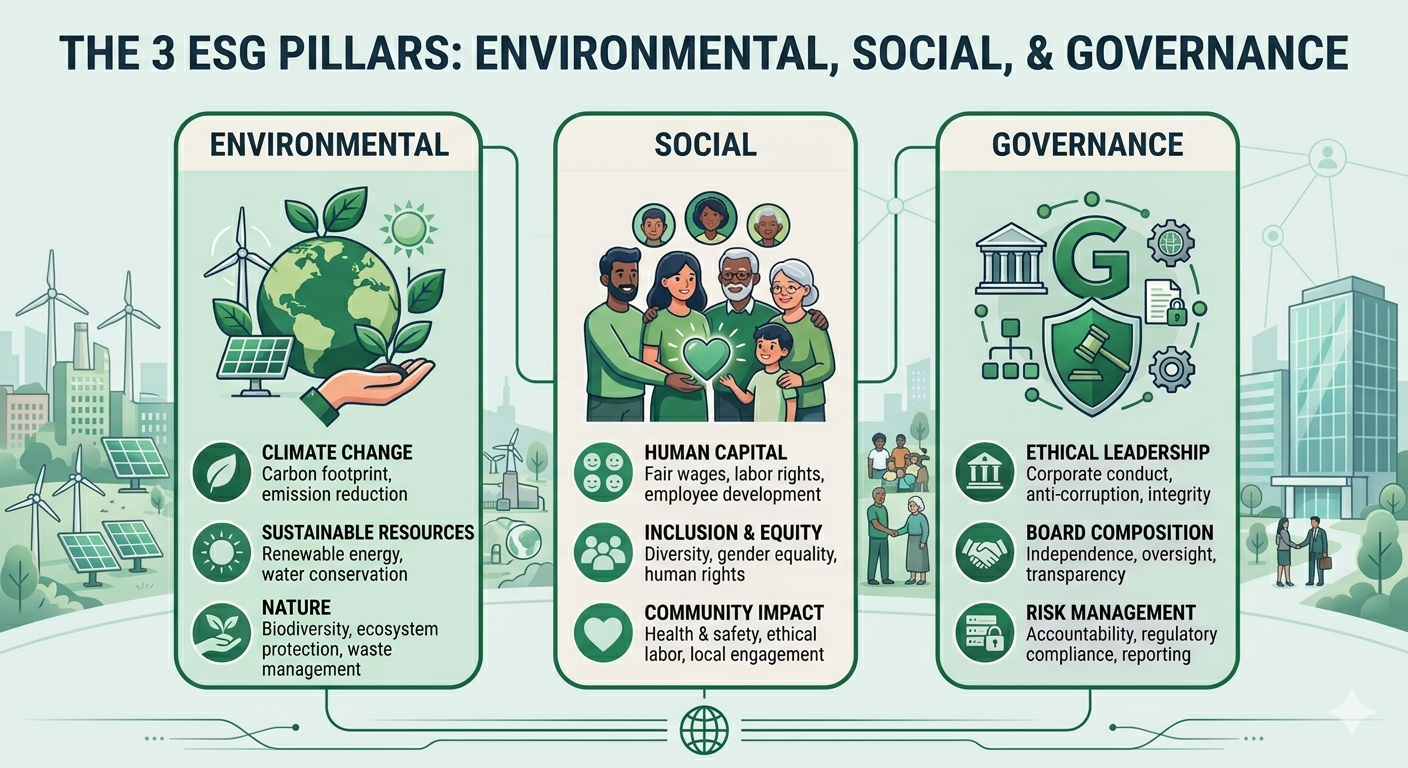
One of the most critical areas where sustainability management consultants provide invaluable expertise is in ESG (Environmental, Social, and Governance) strategy and reporting.
As investors, regulators, and consumers increasingly demand transparency and accountability, businesses must articulate their performance across these three pillars. Consultants help organizations develop robust ESG frameworks, starting with a double materiality assessment to identify the most significant environmental, social, and governance issues relevant to their operations and stakeholders.
They guide companies in setting ambitious yet achievable ESG targets, integrating these goals into overall business strategy, and establishing clear governance structures.
These experts also assist in navigating complex reporting standards such as CSRD, ISSB, and GRI, ensuring accurate data collection, analysis, and disclosure.
By translating complex ESG data into compelling narratives, consultants help businesses enhance their reputation, attract sustainable investment, and mitigate risks, turning compliance into a competitive advantage.
This strategic approach ensures that sustainability efforts are not just performative but are deeply embedded and measurable.
Addressing climate change is paramount, and decarbonization and net zero pathways represent a cornerstone of modern sustainability consulting services.
Consultants assist organizations in meticulously measuring their carbon footprint, encompassing Scope 1, Scope 2, and Scope 3 emissions across their entire value chain. This detailed assessment forms the foundation for developing comprehensive climate strategies, including setting science-based targets (SBTs) aligned with global climate goals.
Experts then work with businesses to identify opportunities for emissions reduction, such as transitioning to renewable energy sources, optimizing operational efficiency, and implementing sustainable procurement practices.
They also help in developing climate risk assessments, enabling companies to understand and prepare for the physical and transitional risks associated with climate change.
Through strategic planning and implementation support, consultants guide businesses in creating credible transition plans towards net zero, ensuring both environmental impact reduction and long-term business resilience.
This proactive approach not only mitigates climate risks but also unlocks new avenues for innovation and competitive advantage.
The shift from a linear ‘take-make-dispose’ model to a circular economy is another transformative area where sustainability management consultants excel.
These services focus on designing out waste and pollution, keeping products and materials in use, and regenerating natural systems. Consultants help businesses integrate circular principles into product design, manufacturing processes, and supply chain management.
This often involves conducting Life Cycle Assessments (LCAs) to evaluate the environmental impacts of products from raw material extraction to end-of-life, identifying hotspots for improvement.
They also guide companies in developing eco-design strategies, exploring alternative materials, and implementing robust waste reduction and recycling programs.
Furthermore, consultants assist in creating business models that support product-as-a-service, repair, reuse, and remanufacturing, fostering greater resource efficiency and resilience.
By embracing circularity, organizations can reduce their environmental footprint, enhance brand reputation, and unlock significant economic value through resource optimization and innovation in product sustainability.
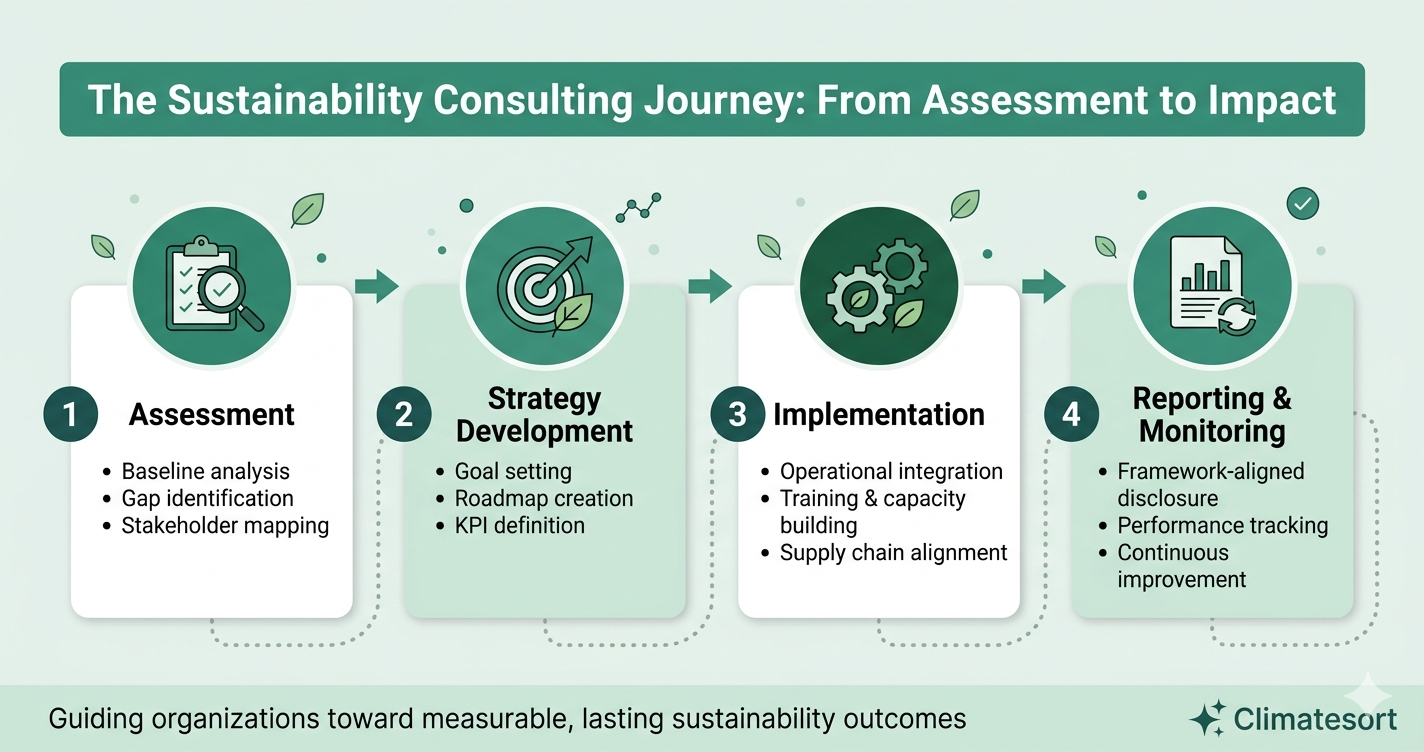
Consultants help organizations develop comprehensive sustainability strategies, conduct materiality assessments to identify priorities, establish science-based targets, and create detailed implementation roadmaps. They also provide guidance on change management and stakeholder engagement.
? Pro Tip: Start with a materiality assessment to identify your highest-impact opportunities.
Offers services that systematically evaluate an organization’s interaction with the environment across multiple dimensions. These assessments provide organizations with data-driven insights to minimize their environmental impact while identifying opportunities for cost savings and operational improvements.
? Success Metric: Companies typically see 15-30% reduction in energy costs within the first year.
Helping organizations redesign their business models and operations to eliminate waste, maximize resource efficiency, and create closed-loop systems. These services include product lifecycle assessments, waste-to-value opportunities, circular supply chain design, and the development of take-back programs to transform traditional linear business practices into regenerative circular models.
⚡ Quick Win: Start with a waste audit – companies often find immediate 20% cost reduction opportunities.
Helping organizations assess, monitor, and improve the environmental and social impacts across their entire value chain. Also assisting with supplier ESG assessments, sustainable procurement strategies, supply chain emissions mapping, supplier engagement programs, and the implementation of traceability systems to ensure responsible and resilient supply chain operations.
? Industry Benchmark: Leading companies achieve 40% lower supply chain emissions through sustainable practices.
Provide comprehensive ESG Reporting and Disclosure services that help organizations collect, analyze, and communicate their environmental, social, and governance performance in alignment with major frameworks like GRI, SASB, and TCFD.
✅ Compliance Check: Ensure alignment with GRI, SASB, and TCFD frameworks.

Offer Stakeholder Engagement services that help organizations identify, prioritize, and effectively communicate with key stakeholders including employees, investors, customers, communities, and regulators about their sustainability initiatives and performance.
? Engagement Insight: Organizations with strong stakeholder engagement programs see 2.5x higher ESG performance scores and 30% better reputation metrics.
Work with organizations to identify, evaluate, and prepare for both physical climate risks (such as extreme weather events and rising sea levels) and transition risks (including regulatory changes and market shifts) that could impact their operations and business model.
Sustainability management consultants offer a comprehensive suite of services designed to embed sustainable practices deeply within an organization’s core operations and strategic vision. These experts act as catalysts for change, guiding businesses through complex environmental, social, and governance (ESG) landscapes to achieve both ecological responsibility and economic resilience.
Their work extends beyond mere compliance, focusing on creating long-term value through innovation, efficiency, and enhanced reputation. From initial assessments to full-scale implementation and reporting, sustainability management consultants provide tailored solutions that address unique business challenges and opportunities.
They help organizations identify their environmental footprint, develop robust sustainability strategies, and implement measurable action plans. This involves a deep dive into operational processes, supply chains, product lifecycles, and corporate governance structures to identify areas for improvement and integrate best practices.
Ultimately, their goal is to empower businesses to navigate the evolving demands of stakeholders, regulators, and the planet, ensuring a sustainable future.
? Risk Alert: 67% of companies face significant climate-related risks in their operations.
Deliver Employee Engagement Programs that transform staff into sustainability champions through customized training, awareness campaigns, and hands-on initiatives. They develop comprehensive programs including green team formations, sustainability challenges, educational workshops, and recognition systems that empower employees to contribute to the organization’s sustainability goals.

? People Power: Companies with active employee sustainability programs report 71% higher staff engagement and 25% lower turnover rates.