Our review highlights the 12 best consulting firms in 2026 that can transform your business model and drive environmental innovation.
Try imagine a world where waste is not the end, but only the beginning. This is the promise of a circular economy, a revolutionary concept that’s shaping how we think about production, consumption and sustainability.
Right now, more and more of the world business leaders are becoming aware of the potential of this new paradigm, eager to move away from the old, linear economy model that has wreaked so much destruction on our planet.
But where does one start on this circular journey? Enter the heroes of our story: the circular economy consulting firms. These are the guides, the mentors, the trailblazers who are helping companies big and small navigate the winding path towards circularity.
In this article, we’ll introduce you to the 12 best of these circular economy consultants. Each has a unique story, a special set of skills, and a track record of turning circular dreams into reality. From innovative startups to established powerhouses, these firms are writing the next chapter in the book of sustainable business.
With dwindling resources and mounting environmental challenges, the concept of a circular economy has emerged as a beacon of hope for sustainable business practices. At its core, a circular economy is an economic model designed to eliminate waste, maximize resource efficiency, and regenerate natural systems. It’s a paradigm shift from the traditional linear “take-make-dispose” approach to a more cyclical “reduce-reuse-recycle” methodology.
In practice, a circular economy manifests in various ways across industries. For instance, in the fashion sector, it might involve creating durable, recyclable clothing or implementing clothing rental services. In the tech industry, it could mean designing easily repairable devices or establishing robust recycling programs for electronic waste.
Here is a QuickTake video from @Boomberg with a short introduction to the concept of the circular economy.
Traditional linear systems depend on abundant cheap materials and energy, following a “take-make-waste” pattern that strains natural resources and fills landfills. Circular systems prioritize material preservation through strategic recycling, refurbishment, and reuse, creating sustainable cycles that reduce environmental impact while maintaining economic value.
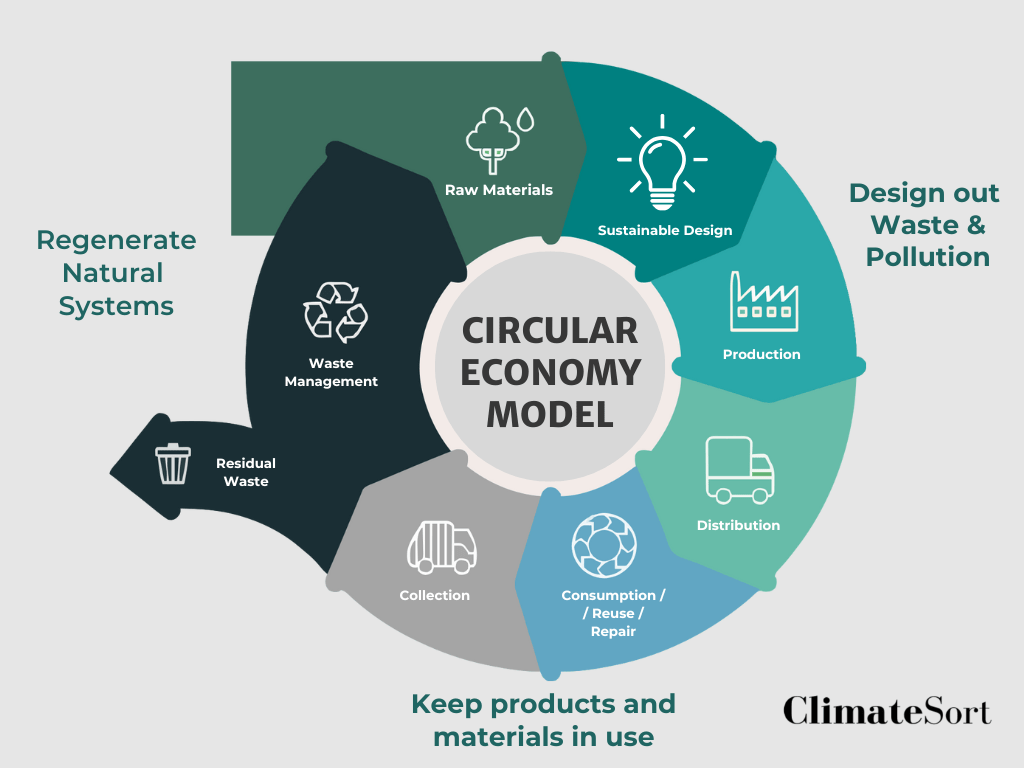
The circular economy is built on three fundamental principles:
Design out waste and pollution: This involves rethinking product design and manufacturing processes to minimize waste from the outset.
Keep products and materials in use: By extending product lifecycles through repair, reuse, and remanufacturing, we can extract maximum value from resources.
Regenerate natural systems: This principle focuses on returning valuable nutrients to the soil and other ecosystems to support natural regeneration.
At the heart of the circular economy lies the principle of designing out waste and pollution. This concept permeates every stage of the economic cycle, from raw materials to residual waste management.
In a circular economy, the emphasis is on using renewable, recycled, or bio-based materials. Companies are increasingly turning to innovative solutions, such as creating fabrics from recycled plastic bottles or developing bio-based alternatives to traditional petrochemical products.
By prioritizing sustainable raw materials, we reduce the need for virgin resource extraction and minimize environmental impact.
Product design plays a crucial role in eliminating waste and pollution. Designers are now focusing on creating products that are durable, repairable, and easily disassembled for recycling.
This approach not only extends product lifespans but also facilitates the recovery of valuable materials at the end of a product’s life.
Circular production processes aim to minimize waste and energy consumption. Advanced manufacturing techniques, such as 3D printing, allow for precise material usage, reducing excess waste.
Additionally, companies are implementing closed-loop systems that recapture and reuse resources within their production facilities.
The second principle focuses on extending the lifecycle of products and materials, which is essential for maximizing resource efficiency.
Innovative distribution models are emerging to support product longevity. Some companies are adopting modular designs that allow for easy upgrades or repairs, while others are exploring product-as-a-service models that incentivize durability and maintenance.
Consumers play a vital role in keeping products in use. The circular economy encourages a shift from ownership to usership, promoting sharing platforms and repair services.
Companies are also developing take-back programs and refurbishment services to extend product lifecycles.
Efficient collection systems are crucial for recovering materials and products at the end of their use phase. Advanced sorting technologies and reverse logistics networks are being developed to facilitate the return of products and materials into the economic cycle.
The principle of regenerating natural systems represents a transformative approach to environmental stewardship, moving beyond mere conservation to active restoration and enhancement of our ecosystems.
This concept is rooted in the understanding that our economic activities can and should contribute positively to the natural world, rather than simply minimizing harm.
In a circular economy, waste management is reimagined as resource recovery. Biological materials are composted or used in anaerobic digestion to produce energy, while technical materials are recycled or upcycled into new products.
Even in a highly efficient circular system, some residual waste is inevitable. However, the goal is to minimize this waste and find innovative ways to reintegrate it into the economic cycle.
For instance, some companies are exploring technologies to convert non-recyclable plastics into fuel or using waste materials in construction. By embracing these principles and focusing on the eight key areas of the economic cycle, we can create a more sustainable and resilient economy.
The benefits of moving toward a circular economy are numerous. Environmentally, it reduces pressure on natural resources and minimizes pollution.
Economically, it can lead to significant cost savings, new revenue streams, and increased competitiveness. Socially, it can create new job opportunities and foster innovation.
The transition from traditional linear business models to circular, can be guided by circular economy consulting firms. These organizations offer a comprehensive suite of services, leveraging their cross-industry expertise to help businesses through the complex process of implementing circular principles. Let’s explore the key areas where these consultants typically offer their specialized knowledge and support.
At the core of circular economy consulting is strategic planning and implementation. Consultants work hand-in-hand with businesses to develop bespoke circular economy strategies that align with their unique goals and industry context. This process typically begins with a comprehensive circularity assessment, where consultants identify opportunities for improvement and potential challenges.
Based on these insights, they help set ambitious yet achievable circular economy targets and establish key performance indicators (KPIs) to measure progress. The consultants then craft detailed roadmaps for implementation, outlining the steps necessary to transition towards a more circular business model. Throughout this process, they provide invaluable assistance with change management, helping organizations navigate the cultural and operational shifts required to embrace circularity fully.
One of the most transformative services offered by circular economy consultants is business model innovation. These experts help companies reimagine their entire approach to value creation and capture, moving away from the traditional “take-make-dispose” model towards more sustainable alternatives.
This might involve developing product-as-a-service models, where customers pay for the use of a product rather than owning it outright.
These firms may also help design sharing platforms that maximize the utilization of assets or products. Additionally, they assist in creating resource recovery and recycling systems that turn waste into valuable inputs, as well as establishing remanufacturing and refurbishment programs that extend product lifecycles.
By rethinking business models through a circular lens, consultants help companies unlock new revenue streams, reduce costs, and minimize environmental impact simultaneously.
Circular economy consultants recognize that a truly circular business model requires a holistic approach to supply chain management. They analyze existing supply chains and identify opportunities to close the loop, creating systems where materials and products circulate continuously. This often involves implementing reverse logistics solutions to facilitate the return and reprocessing of used products or materials.
Consultants also help companies source sustainable and recycled materials, reducing their reliance on virgin resources. Furthermore, they develop supplier engagement programs that encourage and enable partners throughout the supply chain to adopt circular practices.
By optimizing supply chains for circularity, consultants help businesses reduce waste, lower costs, and enhance their resilience to supply chain disruptions.
Integrating circular principles into product and process design is another key area where these firms provide valuable expertise. They guide companies in adopting eco-design strategies that prioritize longevity, repairability, and recyclability, ensuring products are designed with their entire lifecycle in mind.
This might involve selecting materials that are more easily recycled or biodegradable, or designing products for easy disassembly and remanufacturing.
Consultants also help optimize manufacturing processes to minimize waste and resource use, often identifying innovative ways to turn byproducts into valuable inputs for other processes.
By reimagining product and process design through a circular lens, businesses can significantly reduce their environmental footprint while often discovering new opportunities for innovation and differentiation in the market.
From global corporations to emerging startups, here are 12 top consultancies steering the business world toward circular practices with their various expertise.