Master Scope 3 emissions with our comprehensive guide to supply chain decarbonization. Explore real-world examples from industry leaders like Walmart, Apple, and Unilever."
Supply chain decarbonization has become a top priority for CEOs as they face unprecedented climate challenges and growing customer concerns about environmental impact. This guide provides a comprehensive roadmap to a greener business model, focusing on practical strategies and real-world examples. In this guide, you will learn:
Whether you’re a startup or a multinational corporation, this guide breaks down complex concepts into actionable steps, helping you transform your supply chain into a sustainable and positive part of your business model. Together, we’ll explore how to contribute to the global push towards net zero emissions.
For modern companies , particularly in climate tech, understanding and managing Scope 3 emissions has become a strategic imperative. These value chain emissions typically represent over 90% of a company’s carbon footprint, making them the key battlefield in corporate climate action.
Scope 3 emissions represent the indirect greenhouse gas emissions that occur throughout a company’s value chain, excluding those already accounted for in Scope 1 (direct emissions from owned sources) and Scope 2 (indirect emissions from purchased energy). These emissions typically constitute the largest portion of a company’s carbon footprint, often exceeding 90% of total emissions
To better understand Scope 3, consider a smartphone manufacturer: it would include emissions from mining metals for components (upstream), emissions from contract manufacturers assembling the phones (manufacturing), emissions from customers charging and using the devices (downstream), and even emissions from recycling or disposing of old phones (end-of-life).
The magnitude of Scope 3 emissions is staggering. Recent analysis shows that supply chain emissions average 11.4 times higher than operational emissions. For technology and manufacturing companies, this figure can be even more dramatic. This represents both a challenge and an opportunity for businesses looking to lead in sustainability.
The GHG Protocol categorizes Scope 3 emissions into 15 categories, each representing distinct business activities:
Upstream Activities:
Downstream Activities:
Modern businesses face three primary challenges in addressing Scope 3 emissions:
Data Visibility: Getting accurate emissions data from complex global supply chains requires sophisticated tracking systems and supplier cooperation.
Control Limitations: Unlike direct emissions, Scope 3 requires influencing partners’ behaviors and decisions across your value chain.
Scale Complexity: The sheer scope of global supply networks makes implementing reduction strategies a complex orchestration challenge.
Here is a video from RE: TV discussing the complexities of decarbonizing the food supply chains globally.
Forward-thinking companies are deploying cutting-edge strategies to tackle Scope 3 emissions:
Digital Supply Chain Integration: Implementing blockchain and IoT solutions for real-time emissions tracking and verification.
Supplier Innovation Programs: Creating collaborative platforms where suppliers can share best practices and access green technologies.
Circular Design Thinking: Developing products with minimal lifecycle emissions through advanced materials and modular design.
Green Logistics Optimization: Utilizing AI-powered route optimization and alternative fuel vehicles.
Strategic Sourcing Evolution: Building resilient, low-carbon supply networks through strategic supplier partnerships.
As climate tech continues to evolve, managing Scope 3 emissions will become increasingly crucial for business success. Companies that master their value chain emissions now will be better positioned to:
Success in Scope 3 reduction requires a comprehensive strategy that combines technological innovation, supplier collaboration, and business model evolution. For climate tech companies, this represents not just a challenge to overcome, but an opportunity to demonstrate leadership in the transition to a low-carbon economy.

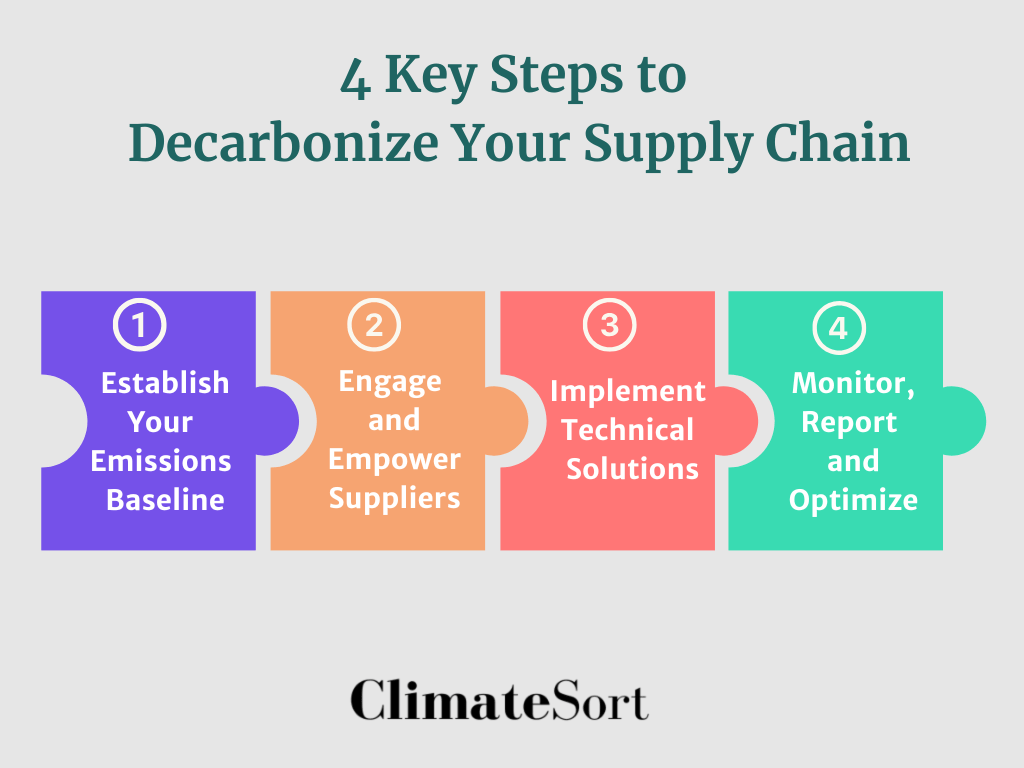
Looking to transform your company to a more eco-friendly model? Your supply chain is a great place to start. This practical framework outlines four essential steps to guide you through the process, and will help you make meaningful progress in reducing greenhouse gas emissions across your entire value chain.
To begin any effective decarbonization effort, you first need to get a clear picture of your current carbon footprint – think of it as taking a snapshot of where you stand today.
This process starts with mapping out your entire supply chain, carefully identifying every significant source of greenhouse gas emissions, from manufacturing facilities to transportation routes.
You’ll want to set up automated systems that can continuously gather emissions data from all your suppliers, making sure everyone is measuring things the same way by following established guidelines like the GHG Protocol.
By analyzing this data, you can create detailed profiles for each supplier, which helps pinpoint exactly where your emissions are highest. This baseline assessment is crucial because it gives you the concrete starting point you need to set realistic reduction targets and measure your progress over time.
Getting your suppliers on board is essential for reducing carbon emissions throughout your supply chain. Think of it as building a team where everyone works together toward the same environmental goals.
Start by educating your suppliers about practical ways they can cut emissions, just like teaching team members new skills. You’ll want to help them set up the right tools and systems to track their progress, and consider offering rewards or benefits to those who make significant improvements.
Creating spaces where suppliers can share their success stories and learn from each other’s experiences can spark innovation and help spread effective solutions across your network.

This collaborative approach ensures that everyone understands their role and has the support they need to contribute to your overall decarbonization goals.
Implementing technical solutions is a crucial step in reducing emissions throughout your value chain. Start by integrating AI-powered logistics optimization, which can help streamline transportation routes and minimize fuel consumption, thereby cutting down on transportation emissions.
Next, focus on energy-efficient manufacturing processes that use less energy and produce fewer emissions during production. Additionally, consider adopting low-carbon materials and embracing circular economy principles, which encourage recycling and reusing resources to lessen environmental impact.

Finally, investing in renewable energy infrastructure for your key suppliers can significantly enhance their sustainability efforts, ensuring that the entire supply chain moves toward a greener future. By taking these steps, you can create a more efficient and environmentally friendly value chain.
Creating a continuous improvement cycle is key to effectively reducing carbon emissions in your business. Think of it as a fitness tracker for your company’s environmental health.
Start by regularly checking your performance against the goals you’ve set, just like tracking your daily steps. Implement advanced monitoring systems to get accurate, real-time data on your emissions – it’s like having a smart watch that constantly measures your heart rate and activity levels.
Develop clear ways to share this information, making your progress visible to everyone involved, similar to sharing your fitness achievements on social media. Use the data you collect to regularly fine-tune your strategy, adapting your approach as you learn what works best, much like adjusting your workout routine for better results.

Finally, keep challenging yourself by setting more ambitious targets over time, just as you would increase your fitness goals as you get stronger. This ongoing cycle of monitoring, reporting, and optimizing ensures that your efforts to reduce emissions continue to improve and evolve, keeping your business on track for a greener future.
Each step in this framework should be tailored to your organization’s specific context and capabilities. Success requires sustained commitment, clear metrics, and regular assessment of progress against defined goals.
Leading companies are integrating these metrics into their standard business performance reviews, ensuring that carbon reduction receives the same attention as traditional business metrics.
| KPI | Description |
|---|---|
| Year-over-year emissions reduction | Measured by supplier tier |
| Supplier reporting percentage | Proportion of suppliers providing emissions data |
| Carbon intensity | Emissions per product unit |
| ROI on decarbonization initiatives | Financial returns on sustainability investments |
By following this structured approach, companies can systematically reduce their supply chain emissions while building more resilient and sustainable business operations. The key is to maintain momentum through consistent execution and regular strategy refinement based on measured results.
Let’s look at three clever ways businesses are cleaning up their supply chains, making everything from sneakers to smartphones a little greener for our planet.
In 2017, Walmart launched Project Gigaton, an ambitious initiative aimed at slashing 1 billion metric tons of greenhouse gas emissions from its global supply chain by 2030. This groundbreaking program has since become a beacon of corporate climate action, demonstrating the power of collaboration in driving sustainable change.
Project Gigaton operates through a multi-faceted approach:
By 2020, Project Gigaton had already made significant strides:
In a stunning development, Walmart announced in February 2024 that it had achieved its billion-ton goal more than six years ahead of schedule. This accelerated success underscores the effectiveness of Walmart’s approach and the commitment of its partners.
Project Gigaton stands as a testament to the transformative power of corporate leadership in addressing climate change. By mobilizing its vast supply chain, Walmart has not only reduced its own environmental impact but has also catalyzed a shift towards sustainability across multiple industries.
Apple, a tech giant known for innovation, has taken a pioneering financial approach to decarbonizing its supply chain. By leveraging green bonds, Apple is driving sustainable change throughout its global network of suppliers and partners.
Apple’s strategy revolves around issuing green bonds to fund environmentally-focused projects:
Apple’s green bond-funded projects include:
Apple’s green bond strategy supports its broader environmental objectives:
Apple’s approach has yielded significant results:
Apple’s use of green bonds exemplifies how financial instruments can be leveraged to drive sustainable transformation in complex global supply chains. By aligning its financial strategy with its environmental goals, Apple is setting a new standard for corporate climate action.
Unilever, a global consumer goods giant, has taken a proactive stance in addressing climate change through its innovative Climate Programme. This initiative focuses on direct supplier engagement to drive significant emissions reductions throughout its complex supply chain.
Unilever’s Climate Programme operates on several key principles:
The Climate Programme encompasses several innovative projects:
Unilever’s Climate Programme has yielded impressive results:
Looking ahead, Unilever aims to:
Unilever’s Climate Programme demonstrates the power of supply chain collaboration in driving systemic change. By engaging suppliers directly and providing concrete support, Unilever is not only reducing its own environmental impact but also catalyzing a broader shift towards sustainability in the consumer goods industry.
The path to supply chain decarbonization is both a challenge and an opportunity. The examples we’ve explored demonstrate that with creativity, determination, and strategic planning, significant emissions reductions are achievable. As regulatory pressures mount and consumer preferences shift, companies that prioritize sustainable supply chains will gain a distinct competitive advantage.
The road ahead may be demanding, but it’s also filled with potential for innovation, efficiency gains, and positive impact. By leveraging the methods and insights shared in this guide, businesses can position themselves as leaders in the low-carbon economy of tomorrow, driving meaningful change while securing their place in a sustainable future.
While initial investments may be required, supply chain decarbonization can lead to long-term cost savings through improved efficiency, reduced energy consumption, and lower exposure to carbon pricing risks. Some companies have reported savings of 5-20% on operational costs after implementing sustainable practices.
SMEs can start by focusing on their most significant emission sources, collaborating with key suppliers, and implementing low-cost efficiency measures. They can also join industry initiatives or seek support from larger customers who may provide resources and guidance for decarbonization efforts.
AI can significantly enhance supply chain decarbonization efforts by optimizing routes, predicting maintenance needs to reduce energy waste, improving inventory management to minimize overproduction, and analyzing vast amounts of data to identify emission hotspots and reduction opportunities.
Industries such as automotive, consumer goods, and technology are often cited as leaders in supply chain decarbonization. Other sectors can learn from their approaches to supplier engagement, innovative technologies, and circular economy principles to accelerate their own decarbonization efforts.
McKinsey & Company: Making supply-chain decarbonization happen
U.S. Environmental Protection Agency (EPA): Supply Chain Guidance
We Mean Business Coalition: How companies can accelerate value chain decarbonization
World Business Council for Sustainable Development (WBCSD): Incentives for Scope 3 supply chain decarbonization
Food and Agriculture Organization of the United Nations (FAO): Carbon footprints in the supply chain: A practical guide for continuous improvement
U.S. Department of Energy (DOE): Chemicals Value Chain Decarbonization: Integrated Solutions for a Complex Challenge
World Economic Forum: Decarbonizing Supply Chains: A Scope 3 Playbook for India
Sourced company profiles you can compare side by side.
Monthly: new rankings, vendor data updates and buyer guides. No spam.
Sent with Brevo. Unsubscribe anytime.