Independent directory · Paid placement never changes rankings. Advertising disclosureData reviewed Oct 2026
Home / Guides / Carbon Capture & Storage (CCU)

The 6 Best Carbon Credit Trading Platforms: Maximize Your Impact

By Dr. Nick BeckerPublished Mar 20, 2025Reviewed by ClimateSort researchUpdated Methodology →
KEY TAKEAWAYS

Looking to trade carbon credits? Explore our detailed look into 6 leading carbon credit trading platforms and understand how carbon credit markets function today.

The global effort to combat climate change has spurred innovative solutions, and carbon credits are a key financial mechanism among them. Carbon credit trading platforms enable companies to offset unavoidable greenhouse gas (GHG) emissions by investing in projects that reduce, avoid, or remove carbon from the atmosphere.

The carbon credit system incentivizes businesses to minimize their carbon footprint while directing funding to crucial climate action initiatives worldwide. This article explores the role of carbon credits in sustainability and highlights some of the major companies and platforms driving this market.

Understanding Carbon Trading and Credits

Carbon trading, also known as carbon emissions trading or the carbon market, is a market-based system designed to reduce GHG emissions by creating financial incentives for companies and countries to lower their environmental impact. At the heart of this system is the carbon credit.

Carbon credits are tradable certificates representing verified reductions or removals of GHG emissions, typically one metric ton of carbon dioxide equivalent (CO2e). These credits are issued under internationally recognized standards, transforming environmental responsibility into a tangible business asset.

Companies worldwide are finding that this system offers both flexibility and efficiency in managing their carbon footprint, allowing them to make strategic decisions about how and when to reduce their emissions.
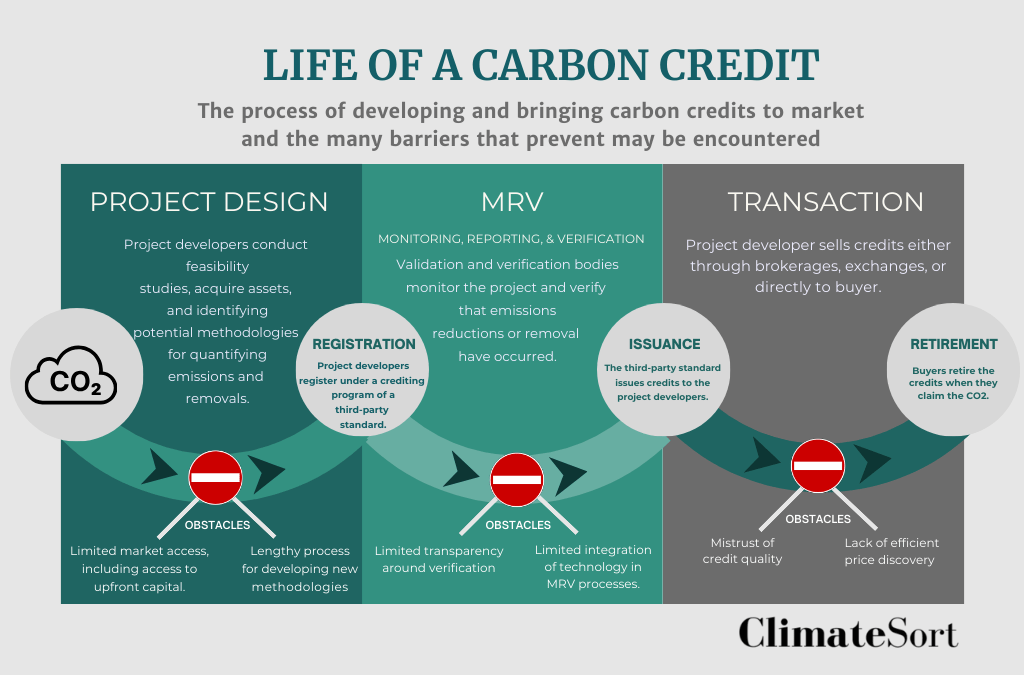
Climatesort Infograph Carbon Credits

How Carbon Trading Works

The foundation of carbon markets worldwide is the cap-and-trade system. A governing authority sets a cap on the total allowable emissions for a specific region or sector.

Companies receive emission allowances, either for free or through auctions, granting them the right to emit up to a certain limit. Companies that emit less than their allowance can sell their excess permits, while those exceeding their cap must purchase additional permits.

Over time, the cap is reduced, driving overall emissions lower and encouraging investment in cleaner technologies. Once a carbon credit is used to offset emissions, it is retired and no longer tradable.

Types of Carbon Markets

The carbon trading ecosystem operates through two primary types of markets:

  • Compliance Markets: These markets operate under mandatory regulations, such as national policies or international agreements like the European Union Emissions Trading System (EU ETS). They serve companies with legal obligations to reduce emissions, providing structure and certainty but with strict requirements and oversight.
  • Voluntary Markets: These markets offer greater flexibility and innovation opportunities. Companies can proactively manage their carbon footprint, often gaining competitive advantages and meeting stakeholder expectations before regulatory requirements take effect. Individuals and businesses can also purchase credits voluntarily to offset their emissions or meet sustainability goals without regulatory requirements.

How to Sell Carbon Credits

Selling carbon credits effectively involves several key stages. Here’s a streamlined guide to help you navigate the process:

Project Development and Certification

This stage involves creating a project that reduces or removes greenhouse gas emissions and getting it properly certified.

Develop a Carbon Offset Project: Implement initiatives that reduce emissions, such as reforestation, renewable energy installations, or energy efficiency upgrades.

Choose a Certification Standard: Select a recognized standard like Verified Carbon Standard (VCS) or Gold Standard.

Third-Party Validation and Verification: Engage independent auditors to validate your project’s design and verify its actual emissions reductions.

Project Registration: Register your validated project with the chosen carbon credit registry.

Selling Your Carbon Credits

Once your project is certified and generating credits, you can proceed with selling them.

Choose Your Market: Decide between the compliance market (regulated by governments) or the voluntary market (driven by voluntary offsets).

Determine Pricing: Research current market rates to set a competitive price for your credits.

List and Sell Credits: Use online exchanges, work with brokers, or directly approach potential buyers.

Additional Tips: If you’re a landowner, explore carbon sequestration programs and document your practices. Businesses can register on trading platforms or collaborate with specialized marketplaces.

Important Considerations

Keep these factors in mind to ensure a successful and ethical transaction.

Long-Term Commitment: Be aware that carbon credit projects often involve commitments spanning a decade or more.

Contract Review: Carefully examine all terms to ensure fair compensation and mitigate potential liabilities.

Market Research: Stay informed about market trends and regulatory updates to maximize your returns.

Carbon Credit Trading Platforms - Renewable Energy Projects

The Importance of Carbon Trading

Carbon trading incentivizes companies to innovate and adopt greener practices by making pollution costly and rewarding emission reductions.

It also channels investments into climate-friendly projects globally, fostering sustainable development and helping nations meet international climate commitments like those under the Paris Agreement.

Carbon Exchanges: Marketplaces for Carbon Credits

Carbon credit marketplaces facilitate the buying and selling of carbon credits, connecting entities seeking to offset their emissions with those who have successfully reduced or removed GHGs from the atmosphere. Key features of carbon exchanges:

  • Trading Platform: Offer a centralized platform, streamlining the trading process for both buyers and sellers.
  • Price Discovery: Contribute to the establishment of market-driven carbon credit prices for carbon credits by consolidating numerous buyers and sellers.
  • Standardization: Implement standards for the carbon credits traded, ensuring a consistent level of quality.
  • Market Focus: Some exchanges focus on compliance markets, assisting entities in meeting regulatory obligations, while others cater to voluntary markets, serving businesses and individuals who aim to voluntarily offset their emissions.

A carbon trade exchange typically handle two primary types of carbon credits:

  • Carbon Offsets: Verified reductions or removals of GHGs from the atmosphere, often originating from projects such as reforestation initiatives or renewable energy developments, can also be achieved through investments in innovative technologies that generate high-quality low carbon fuel offsets.
  • Carbon Allowances: Permits that grant the holder the right to emit a specific quantity of GHGs, frequently utilized in cap-and-trade systems.

Carbon exchanges are essential in the global pursuit of reducing GHG emissions, providing an efficient mechanism for trading carbon credits and contributing to establishing a tangible price for carbon emissions.

The Technology Edge

Modern carbon trading has evolved significantly, with platforms leveraging cutting-edge technology to ensure efficiency, transparency, and security.

Blockchain technology has revolutionized how credits are tracked and verified, while artificial intelligence helps companies make smarter trading decisions and identify the most cost-effective reduction opportunities.

This infrastructure allows businesses to manage their carbon credits with precision and confidence, using real-time pricing, automated verification, and sophisticated analytics tools.

6 Leading Carbon Credit Trading Platforms

Here are some of the best carbon credit trading platforms available today, recognized for their innovative approaches and significant market presence.

xpansiv_logo

Xpansiv

HQ Location
New York, New York
Founded
2016
Num. of Employees
201-500
Xpansiv Homepage

Xpansiv stands as the world’s largest integrated market infrastructure provider for the global energy transition. Their flagship platform, CBL, dominates the carbon credit spot exchange market, controlling roughly 40% of voluntary carbon market trade.

Xpansiv dominates the voluntary carbon market through its CBL spot exchange platform. The platform handles roughly one-quarter of global carbon credit trading volume.

Trading Infrastructure

CBL Exchange Platform

  • Provides real-time trading with transparent order books
  • Offers same-day settlement to reduce credit and delivery risks
  • Connects with major registries like VCS, ACR, Gold Standard, and Puro.earth
  • Lists over 2-3 million tons of project credits daily

Standardized Contracts

  • GEO suite covers distinct market segments
  • N-GEO focuses on nature-based credits
  • C-GEO specializes in technology-based credits
  • SD-GEO targets sustainable development projects

Portfolio Solutions

Multi-Registry Management

  • Xpansiv Connect enables unified portfolio views
  • Manages positions across 12 global carbon registries
  • Processes over one billion asset transfers annually
  • Streamlines credit lifecycle workflows

Recent Innovations

The platform launched carbon removals-only trading in December 2024, enabling:

  • Discrete market views for removal credits
  • Separate portfolio management for removals
  • Integration with major carbon registries
  • Trading of both nature and technology-based removal credits

Xpansiv’s comprehensive infrastructure creates transparent markets for environmental commodities, connecting over 600 global market participants from 50 countries.

aircarbon_pte_ltd_logo

AirCarbon Exchange

HQ Location
Abu Dhabi
Founded
2019
Num. of Employees
11-50
ACX Homepage

ACX stands as a pioneering force in environmental markets. Their digital exchange transforms carbon credit trading through blockchain technology and traditional commodities architecture.

The platform delivers transparent pricing and instant settlement for carbon credits. Market participants enjoy low fees, efficient trading, and clear price discovery.

ACX has rapidly evolved to become a key player in the voluntary carbon market, offering a range of services and innovative solutions deliver a comprehensive suite of carbon credit products through their digital exchange platform. Let’s explore their main offerings.

Global Carbon Exchange: ACX provides a platform that connects project developers, corporations, industries, and nations worldwide, facilitating access to diverse environmental instruments.

Blockchain Technology: The exchange leverages distributed ledger technology (DLT) to create securitized carbon credits, enabling instant settlement of transactions and providing transparency in pricing.

Efficient Trading: ACX offers low fees, efficient trading, settlement risk mitigation, and transparent pricing, making it attractive for various market participants.

Diverse Product Offerings: The platform supports trading of various environmental instruments, including carbon credits, renewable energy certificates, and biofuels.

Regulated Exchange: In 2022, ACX became the world’s first regulated carbon credit exchange and clearing house in Abu Dhabi Global Market (ADGM), enhancing trust and security in carbon credit trading.

Carbon TradeXchange

Carbon TradeXchange (CTX)

HQ Location
London, England
Founded
2008
Num. of Employees
11-50
Carbon Trade Xchange Homepage

Carbon Trade Exchange (CTX) is the world’s first global electronic exchange for the voluntary carbon market. Operating since 2009, CTX provides a digital platform for trading carbon credits and offsets 24/7/365. The exchange facilitates spot trading of carbon credits from various internationally recognized standards, including Gold Standard, Verra VCS, and United Nations CDM credits.

CTX offers a member-based system where buyers and sellers can trade carbon credits directly. The platform supports multiple currencies and allows for trading in lots as small as 100 tons of CO2e. It provides real-time pricing, immediate settlement, and guaranteed delivery of credits.Key features of CTX include:

  • Free membership for buyers and sellers
  • Low transaction fees
  • Direct registry connections for immediate transfer of credits
  • Support for multiple carbon credit standards
  • Carbon footprint calculation and offsetting services
  • Project development assistance

CTX aims to increase transparency and efficiency in the voluntary carbon market by providing a user-friendly interface for both large corporations and smaller entities to participate in carbon trading. 

icedubai_logo

Intercontinental Exchange (ICE)

HQ Location
Dubai
Founded
2000
Num. of Employees
2-10
ICE Homepage

The Intercontinental Exchange (ICE) is a leading global operator of financial and commodity markets, including stock exchanges and futures markets. Founded in 2000 in Atlanta, Georgia, ICE has grown to become a crucial player in facilitating the smooth operation of global financial markets through its advanced electronic trading platform.

ICE offers a wide range of services related to carbon credits and environmental markets:

  1. Carbon Credit Futures: ICE provides various carbon credit futures contracts, including Nature-Based Solutions (NBS) futures and CORSIA-compliant carbon credit futures. These contracts allow market participants to buy, sell, and hedge carbon credits from different vintages and project types.
  2. ICE Carbon Reference Entity Data Service (ICE CRED): This service normalizes, standardizes, aggregates, and supplements carbon credit reference data from global registries. It assigns unique ICE Carbon Credit Reference Identifiers (ICE CREF) to carbon credits for each project and vintage, facilitating their use and reducing operational risk.
  3. Environmental Registry Technology Services: ICE plans to launch ICE GreenTrace™, a registry technology service designed to support registries and registry users across the life cycle of a carbon credit. This service aims to bring state-of-the-art infrastructure to support the growth of carbon markets.
  4. Carbon Indices: ICE offers the ICE Carbon Futures Index Family, which comprises pricing from the four most actively traded carbon markets worldwide.
  5. Data and Analytics: ICE provides comprehensive data services, analytics, and technology solutions to support financial institutions, traders, and market participants in making informed decisions about carbon markets.

By offering these services, ICE plays a significant role in the development and growth of global carbon markets, facilitating transparency, liquidity, and efficient pricing mechanisms for carbon credits and related environmental products.

carbonplace_logo

Carbonplace

HQ Location
Dubai
Founded
2022
Num. of Employees
11-50
Carbonplace Homepage

Carbonplace was developed as a coll